
Career In Digital Marketing
To start a career in digital marketing, learn the basics, choose one skill, build real projects, create a small portfolio, and apply for entry level roles with proof of work. That is the clean answer, not the fake one where someone tells you to watch three videos and call yourself a strategist. If you feel confused at the start, that is normal because digital marketing has many moving parts. Most beginners do not need magic, they need a clear path, steady practice, and fewer motivational reels pretending to be education.
Digital marketing is a good career because every business wants attention, leads, sales, and loyal customers online. From a clothing brand in Lahore to a software house selling overseas, businesses need people who can bring the right audience and measure results. That is where practical marketing skills become valuable, especially when you can connect online activity with sales. My Digital People helps businesses solve this exact problem with SEO, PPC, social media, content, web design, and complete digital growth services.
If you want to learn the field properly, study how real campaigns are planned, tracked, and improved through professional digital marketing services. Do not build your whole understanding from random posts shouting about shortcuts. Shortcuts are cute until you sit in an interview and cannot explain what a conversion rate is. Learn the work, practise the work, and then show the work.
What Does A Digital Marketer Actually Do?
A digital marketer helps a business reach people online and turn that attention into action. That action can be a website visit, form submission, product order, WhatsApp message, app install, or repeat purchase. Sounds simple, but obviously the internet made it look like everyone with Canva and a caption is now a digital marketer. Come on, real digital marketing needs planning, audience research, content, testing, reporting, and clear thinking.
Daily work can include keyword research, writing content, planning social posts, running Google Ads, checking analytics, improving landing pages, sending emails, and reporting performance. You are not just posting pretty graphics and hoping the algorithm feels generous. You are helping a business make money without burning cash like it grows on trees. That means every task should connect to a clear objective, not just a pretty dashboard screenshot.
Main Digital Marketing Career Paths
Digital marketing is not one job. It is a group of skills, and beginners should pick one primary path first before learning the basics of the others. Trying to master everything in one month is adorable, but no. Start with one direction, build confidence, then expand once you have actual experience.
SEO means search engine optimisation, and in simple words, it helps websites show up in Google search. Content marketing uses articles, videos, and guides to educate people and attract the right audience. Social media marketing builds reach and engagement on platforms like Instagram, Facebook, TikTok, and LinkedIn. These three paths are common starting points because they are easier to practise without a huge budget.
PPC means paid ads, such as Google Ads or Meta Ads. Email marketing is about sending useful messages to customers and leads instead of spamming people like it is 2009. Marketing analytics tracks what worked, what failed, and what should be improved next. Ecommerce marketing focuses on selling products through online stores and improving the full buying journey.
Not sure which path fits you? Good, that means you are thinking instead of copying someone else’s career plan like homework. Start by testing small tasks from each path and notice what feels natural. Your first choice does not have to be your forever choice, but it does need to get you moving.
- SEO content writing
- Paid ads setup
- Social media planning
- Email campaign building
- Analytics report making
- Ecommerce sales growth
- Landing page testing
How To Start A Career In Digital Marketing With No Experience
You start by building proof, not by collecting certificates like prize stickers. Certificates help, but a portfolio gets attention because employers want to see that you can think, execute, and explain results. If you have no experience, your job is to create small projects that show practical skill. Waiting for someone to hand you experience is not a strategy, it is just delay with nicer wording.
First, learn marketing fundamentals. Understand audience research, customer journey, brand positioning, content strategy, conversion rate, and campaign performance. Big words? Relax, it simply means knowing who you are targeting, what they care about, what message works, and what result came from it.
Second, choose one skill. If you like writing and research, start with SEO or content. If you enjoy numbers, try PPC or analytics, and if you like communities and trends, social media marketing makes sense. If you enjoy systems and customer follow ups, email marketing is a strong choice.
Third, build one real project. Create a small website, write five useful articles, track visits, and improve pages. Or build a mock ad campaign with keywords, audience, ad copy, budget, and expected metrics. No client? Make a sample project and stop waiting for permission.
Do You Need A Degree For Digital Marketing?
No, a degree is not always required for digital marketing. Let’s be real, many agencies, startups, freelancers, and small businesses care more about your work than your university name. If you can show results, explain your decisions, and use tools properly, you have a chance. A strong portfolio can often open doors that a weak CV cannot.
A degree can still help, especially in corporate companies in Pakistan and abroad where degrees are often used as a filter. It can also give you marketing theory, communication skills, and internship access. So no, a degree is not useless. It is just not magic, and it will not save you if you have no practical skills.
If you already have a degree in business, English, media, IT, design, economics, or even psychology, you can connect it to digital marketing. If you do not have one, build a stronger portfolio and prove that you can do the work. Nobody owes you a job because you watched a course at 2 am. The good news is simple, a strong project can speak louder than a weak CV.
Core Digital Marketing Skills Employers Look For
Employers want people who can learn fast, communicate clearly, and measure results. They do not want someone who says, ‘I boosted engagement,’ but cannot explain what engagement means. Straight up, that is how interviews go downhill. Learn the skills that help you prove impact, not just sound busy.
Start with marketing basics. Learn how customers move from awareness to interest, then from interest to purchase. This is called a marketing funnel, and it helps you understand why one person needs an educational post while another needs a discount offer. Without this, your campaigns become random posts with hopeful captions.
Then learn channel skills. For SEO, study keyword research, on page SEO, search intent, internal linking, and content structure. For PPC, understand campaign setup, bidding, landing pages, and cost per lead. For social media, learn content calendars, platform behaviour, hooks, captions, and reporting.
Measurement matters because businesses care about results. Conversion rate means the percentage of people who take the action you want. Customer acquisition cost means how much you spend to get one customer, while return on ad spend means how much revenue you get from your ad spend. UTM tracking means adding small tags to links so you can see where traffic came from, which sounds fancy but is actually very practical.
Learn Google Analytics, Google Search Console, spreadsheets, conversion rate, click through rate, customer acquisition cost, and return on ad spend. If that sounds scary, good, because you found the part most beginners avoid. Learning measurement gives you an edge because it helps you speak the language of business. You can use official resources like Google Search Central to understand how search works from the source, not from someone shouting hacks on YouTube.
Choose One Specialisation First
Cut the nonsense and stop trying to become a full stack digital wizard in 30 days. Pick one lane first so you can practise properly and build proof that looks credible. You can expand later after you have real confidence. Right now, focus beats pretending you are an expert in seven things.
If you like writing, choose SEO or content marketing. You will research topics, write pages, optimise headings, and improve search visibility. If you like design and people, choose social media marketing. You will create content ideas, manage calendars, and study audience response.
If you like data and testing, choose PPC or analytics. You will compare keywords, budgets, clicks, conversions, and reports. If you like customer communication, choose email marketing. You will build welcome emails, offers, customer segments, and automation flows.
Still unsure? Pick the skill that feels easiest to practise this week, not forever. Momentum beats overthinking because you learn more by doing one useful task than by watching ten comparison videos. If you are in Pakistan and want local context, practical earning routes, and beginner friendly direction, read how to start digital marketing in Pakistan for a more market focused view.
Build A Digital Marketing Portfolio Before Applying
Your portfolio is your proof. Without it, your resume is mostly vibes, and vibes do not survive a serious hiring manager. A beginner portfolio does not need famous clients or massive results. It needs clear thinking, practical work, and honest reporting.
Start with a niche website. Pick a topic you understand, such as fitness for students, budget fashion, home baking, local travel, mobile accessories, or small business tips. Write five optimised pages with proper titles, headings, internal links, useful images, and clear calls to action. This gives you something real to discuss in interviews instead of saying you are passionate for the tenth time.
Next, create a campaign brief. Choose a fake business or a real local one with public information. Define the objective, target audience, platform, message, budget assumption, success metrics, and reporting plan. You do not need to spend money to show that you understand campaign thinking.
Then build an email sequence. Write a welcome email, an educational email, and a sales email. Explain who receives each email and why, then add subject lines and click goals. Keep it clean because nobody wants essays in their inbox unless they signed up for pain.
Finally, create a performance report. Use sample data if needed and show sessions, clicks, impressions, conversion rate, cost per lead, or engagement rate. Explain what changed, what worked, what failed, and what you would test next. This shows that you can think beyond execution and actually improve a campaign.
Here is a simple beginner case study format. Objective, get more visits for a small bakery page. Action, write one SEO page and share it on Facebook groups. Result, get 120 visits and 8 WhatsApp clicks in two weeks, then explain that local keywords worked better than broad keywords.
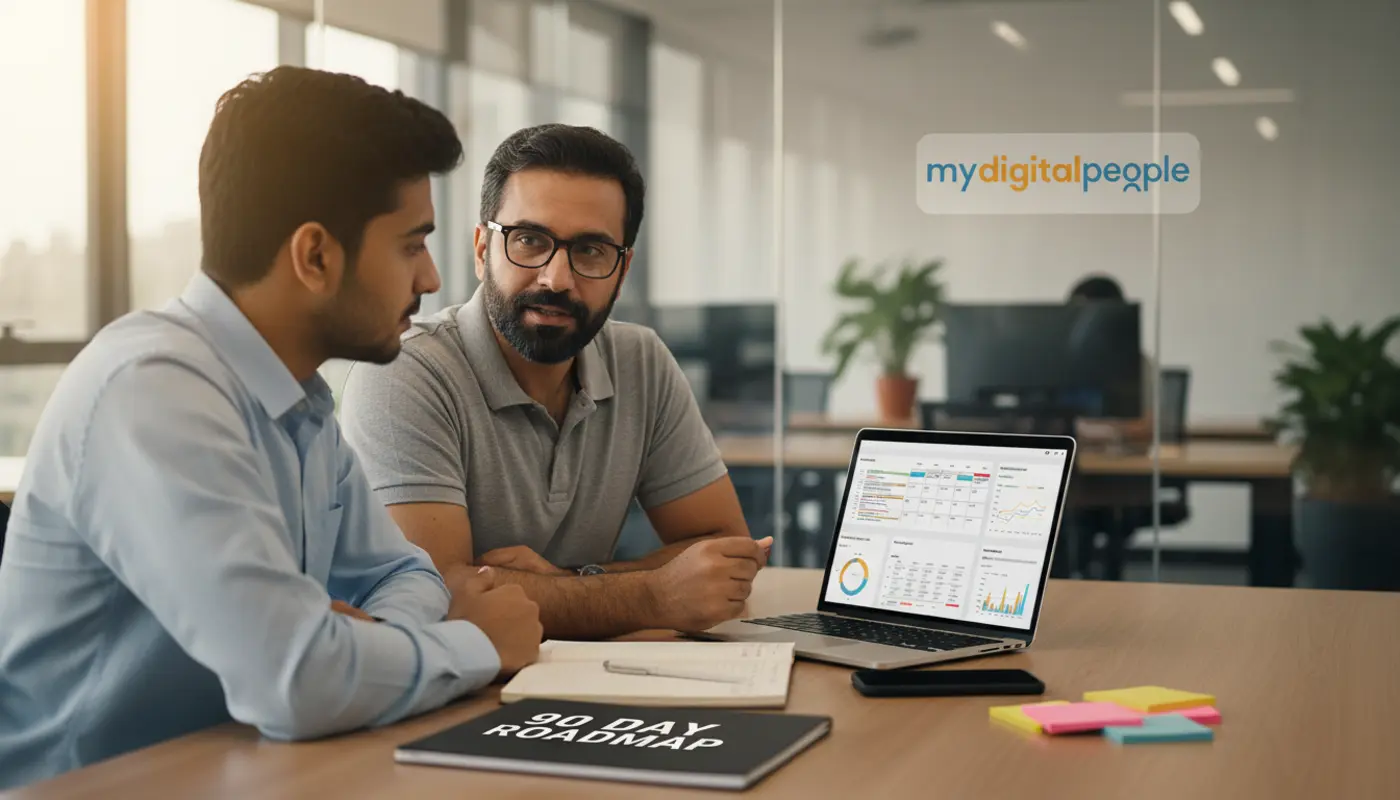
A Practical 90 Day Roadmap
Here is what is actually happening. You do not need five years to become job ready for a junior role. You need focused practice for around 90 days, if you stop scrolling and actually work. This plan is not fancy, and that is the point because fancy plans usually look nice and die in your Notes app.
Days 1 To 30 Learn The Basics
Study digital marketing fundamentals, customer journey, SEO, social media, PPC, email, and analytics. Do not go too deep into everything at once because that is how beginners burn out and learn nothing properly. Learn enough to understand how the parts connect. Then choose one main skill that you will practise more seriously.
Set up a simple website or project folder. Create a learning tracker and write down what you study, what you practise, and what you produce. Your brain is not Google Drive, so save things properly. This small habit will make your learning easier to review and your portfolio easier to build.
Days 31 To 60 Build Real Assets
Create content, a keyword map, a social content plan, a mock Google Ads campaign, or an email sequence. Use free tools where possible because Pakistani beginners do not need expensive software on day one. The goal is to produce assets that show your thinking. Do not wait until everything looks perfect because perfect usually means unpublished.
Track your work in a spreadsheet. Note impressions, clicks, rankings, engagement, or estimated costs. The point is not perfection, it is learning how campaigns are planned and judged. Once you can explain what you did and why, you are already ahead of many beginners.
Days 61 To 90 Package And Apply
Turn your projects into two or three case studies. Each case study should include objective, audience, strategy, tools, execution, results, lessons, and next steps. Keep it simple and visual so hiring managers can understand your work quickly. Do not hide your thinking behind fancy words because clear beats clever.
Update your CV and LinkedIn profile. Apply for roles like digital marketing assistant, SEO assistant, content coordinator, social media coordinator, PPC assistant, ecommerce assistant, marketing intern, or junior digital marketing executive. Customise your application for the role instead of sending the same boring CV everywhere. Yes, it takes longer, and yes, that is why it works better.
Certifications Worth Your Time
Certifications can help when they teach current skills and include practice. They show that you understand basic terms and tools, which is useful at beginner level. Fine, useful, but they do not prove you can grow a business. Treat certificates as support, not as the main product you are selling.
Look for courses that include hands on projects, analytics, campaign planning, tool training, and portfolio work. Avoid courses that promise guaranteed income after two weeks. Honestly, if someone promises that, protect your wallet. Real skills take time, testing, mistakes, and actual implementation.
Good beginner areas include Google Analytics, Google Ads basics, SEO fundamentals, content marketing, email marketing, and social media advertising. Learn one tool deeply instead of collecting ten half understood certificates. A certificate plus a case study is stronger than a certificate alone. That combination shows both learning and application.
How To Get Your First Digital Marketing Job
Apply with proof, not desperation. Employers see hundreds of generic CVs, and ‘hardworking and passionate’ is not a strategy. Everyone writes that, even people who disappear after lunch. Your application should show what you can do, how you think, and why you fit the role.
Match your portfolio to the job description. If the role asks for SEO, show keyword research and optimised content. If it asks for social media, show a content calendar and performance notes. If it asks for PPC, show a campaign structure and budget logic.
Use measurable language in your CV and portfolio. Say, ‘Created five SEO pages based on keyword research,’ or ‘Built a three email sequence for lead nurturing.’ Better yet, explain why you made those choices. Thinking matters because marketing is not just clicking buttons in tools.
Network like a normal human. Message professionals with specific questions instead of sending ‘Please guide me’ and expecting a full career plan for free. Ask one clear question and respect their time. Feeling nervous before applying is normal, but apply anyway because confidence comes after action, not before it.
How AI Is Changing Digital Marketing Careers
AI tools are changing digital marketing, but they are not replacing people who can think. They are replacing lazy work, repetitive work, and low effort content that nobody wanted anyway. If your entire skill is copying prompts and pasting content, yes, worry. If you can plan, verify, improve, and measure, you still have value.
Use AI for research ideas, content outlines, ad variations, reports, and workflow support. Then verify facts, improve the message, match the brand voice, and protect user data. That final human judgment is where value lives. Tools can speed up work, but they cannot understand a business context properly without a skilled person guiding them.
Employers now care about automation, analytics, personalisation, and responsible tool use. Learn how to use technology without sounding like a robot wearing a marketer costume. Keep your work accurate, useful, and aligned with business goals. That is the difference between a digital marketer and someone playing with tools all day.
Salary And Career Growth Reality
Digital marketing salaries vary by country, city, role, company size, and skill level. U.S. salary data does not apply directly to Pakistan, so stop comparing your first Lahore internship to a New York specialist role. That is not ambition, that is bad math. Compare your progress with the local market and your actual skill level.
In Pakistan, beginners often start with internships, junior roles, freelance gigs, or assistant positions. Strong portfolios, English communication, analytics skills, and international client exposure can increase earning potential faster. Agencies, ecommerce brands, software houses, and service businesses all hire digital marketing talent. The better you become at linking marketing work to business results, the more valuable you become.
A common path is intern, assistant, specialist, strategist, manager, head of marketing, consultant, or agency owner. Growth depends on how fast you learn, how clearly you communicate, and how well you solve real business problems. Titles are nice, but results pay better. Keep building proof and your career options will expand.
Final Checklist To Start Strong
Choose one specialisation, build one project, learn measurement, create case studies, and apply with proof. Keep improving every month because digital marketing rewards people who test, learn, and adapt. Do not pretend that another course will magically make you ready. Today, choose one skill and create your first project folder.
Write the project goal, the audience, and the first task. Then do the task instead of planning your perfect future career in a notebook for three more weeks. Revolutionary, I know, but action is still the part most beginners avoid. The people who win are usually not the smartest, they are the ones who keep doing useful work consistently.
Final Thoughts
Starting a career in digital marketing is practical if you stop chasing shortcuts and start building proof. Learn the basics, choose one skill, create real or sample projects, and explain your results clearly. A degree can help, certificates can help, and tools can help, but none of them replace practice. If you want to stand out in Pakistan’s digital market, show that you can think, execute, measure, and improve.
Frequently Asked Questions
Can I Start Digital Marketing With No Experience?
Yes, you can start digital marketing with no experience if you build practice projects. Create a small website, write sample content, plan mock campaigns, and track results. Employers need proof that you can do the work, not just proof that you watched tutorials.
Can I Become A Digital Marketer Without A Degree?
Yes, many digital marketing roles value skills and portfolios more than degrees. A degree can help in some corporate jobs, especially in Pakistan, but it is not always compulsory. If you do not have a degree, build stronger case studies and show clear practical work.
Which Digital Marketing Skill Should I Learn First?
Start with SEO or content marketing if you like writing, research, and problem solving. Choose PPC or analytics if you enjoy numbers, testing, and reports. Pick one skill first so you can practise properly instead of confusing yourself with everything at once.
How Long Does It Take To Become Job Ready?
With focused daily practice, many beginners can become ready for junior roles in around 90 days. That means building projects, learning tools, and creating case studies, not just watching videos. Your progress depends on consistency and the quality of your practice.
Are Certifications Necessary For Digital Marketing?
Certifications are useful, but they are not enough alone. They can help you understand tools and basic concepts, especially at beginner level. Pair them with portfolio projects, reports, and clear examples of your work if you want employers to take you seriously.



Leave a Reply