
You have probably heard both terms thrown around in every marketing conversation. But here is the thing: most people use them interchangeably, and that is a costly mistake.
Understanding the difference between digital and social media marketing is not just a matter of terminology. It directly affects how you spend your budget, what channels you invest in, and how fast your business actually grows.
In this guide, we break down both concepts clearly, compare them side by side, and help you figure out what your business truly needs. Whether you are a startup founder, an ecommerce brand exploring White Label Ecommerce options, or a marketing manager trying to sharpen your strategy, this post is written for you.
What Is Digital Marketing?
Digital marketing is the broad umbrella. It covers every type of marketing activity that happens online or through digital channels. Think of it as the parent category.
Digital Marketing Services include things like:
- Search Engine Optimization (SEO)
- Pay-Per-Click Advertising (PPC)
- Email Marketing
- Content Marketing and Blogging
- Affiliate Marketing
- Influencer Marketing
- Mobile Marketing
- Social Media Marketing (yes, it is a part of digital marketing)
According to a 2025 Statista report, global digital advertising spending reached over $740 billion and is expected to surpass $870 billion by 2026. That tells you just how massive and diverse digital marketing has become.
Key Characteristics of Digital Marketing
Digital marketing is multi-channel. Your brand can show up on Google search results, in someone’s inbox, on a YouTube pre-roll ad, and on a blog comparison article all in the same day.
It is also highly measurable. With tools like Google Analytics, you can track impressions, clicks, conversions, and revenue down to the last cent. This level of data visibility is what makes digital marketing so powerful for growth-focused businesses.
What Is Social Media Marketing?
Social Media Marketing (SMM) is a specific type of digital marketing. It focuses exclusively on building presence, engagement, and growth through social media platforms.
These platforms include Facebook, Instagram, LinkedIn, TikTok, X (formerly Twitter), Pinterest, and YouTube. The goal is to connect with your audience where they already spend their time.
Social media marketing activities typically involve:
- Creating and posting organic content (images, reels, carousels, stories)
- Running paid social ads (Facebook Ads, Instagram Ads, LinkedIn Ads)
- Community management and responding to comments or DMs
- Collaborating with influencers and brand ambassadors
- Running giveaways and social campaigns
- Tracking engagement metrics like likes, shares, saves, and reach
As of early 2026, there are over 5.2 billion social media users worldwide. That is more than 60% of the global population, which is exactly why brands invest so heavily in social-first strategies.
Difference Between Digital and Social Media Marketing: The Core Breakdown
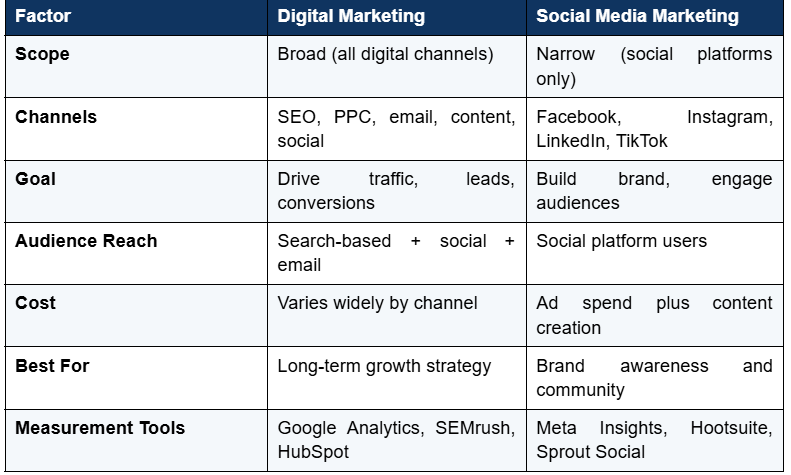
Here is the simplest way to think about it. Digital marketing is the ocean, and social media marketing is one of many rivers that flow into it.
Every social media marketing campaign is a digital marketing campaign. But not every digital marketing campaign involves social media. That is the fundamental distinction.
Quick Comparison Table
Which One Does Your Business Actually Need?
This is the question that actually matters. And the answer depends entirely on your goals, your target audience, and where your customers are in their buying journey.
Choose Digital Marketing If…
- You want to dominate Google search results for your product or service
- You are running an ecommerce store and want consistent revenue through multiple channels
- You need a long-term strategy that generates compounding results over time
- You want to capture demand that already exists (people actively searching for what you sell)
Choose Social Media Marketing If…
- You want to build brand awareness and a loyal community quickly
- Your product has strong visual appeal (fashion, food, fitness, beauty)
- You want to create demand and introduce your product to people who did not know they needed it
- You are looking for direct interaction with your target audience
Honestly, the most effective businesses do not choose between the two. They integrate both. For example, a brand running paid Google Ads can retarget those same visitors with Instagram ads, then nurture them through email marketing. That is a full digital marketing ecosystem at work.
Common Mistakes Businesses Make When Choosing a Strategy
Even smart marketers fall into predictable traps. Here are the most common ones to avoid:
- Treating social media as the entire marketing strategy: Many small businesses pour everything into Instagram and Facebook, ignoring SEO and email entirely. When the algorithm changes, their traffic collapses overnight.
- Ignoring intent: Digital marketing channels like SEO capture people who are actively looking to buy. Social media reaches people in passive discovery mode. Understanding this distinction changes how you craft your message.
- Skipping the analytics: Running campaigns without tracking data is like driving with your eyes closed. Always set up proper conversion tracking before spending a single rupee or dollar on ads.
- Copying competitors blindly: Just because a competitor is active on TikTok does not mean TikTok is right for your brand. Always let your audience data guide your channel selection.
- Neglecting content quality: Whether it is a blog post for SEO or a reel for Instagram, poor-quality content kills performance. Invest in good creative, always.
Expert Tips to Get the Most Out of Both Channels
These tips come from real campaign experience, not theory.
Tip 1: Start With SEO as Your Foundation
SEO takes time, but it builds long-term authority and organic traffic. Start investing in it from day one, even if social media is your primary short-term channel. A strong SEO foundation means free traffic that compounds over the years.
Tip 2: Use Social Media to Test and Validate Content Ideas
Before writing a 2,000-word blog post, test the concept as a short social media post or poll. If it gets strong engagement, then it is worth the deeper investment. Social media is your free testing ground.
Tip 3: Build an Email List From Both Channels
Social platforms can restrict your reach anytime. Your email list is the one asset you truly own. Use both SEO traffic and social media followers to drive sign-ups. This way, you are never fully dependent on an algorithm.
Tip 4: Repurpose Content Across Channels
A well-researched blog post can become a LinkedIn article, a carousel for Instagram, a short video script for TikTok, and an email newsletter. Smart content repurposing stretches your marketing budget without stretching your team thin.
A Note on White Label Ecommerce and Marketing Strategy
If you are running a white label E-commerce business, your marketing strategy requires even more precision. You are often operating with tighter margins and need every marketing dollar to perform.
For white label brands, SEO and content marketing tend to provide the strongest long-term return. Building product-specific landing pages optimized for search intent captures buyers who are already ready to purchase.
Social media marketing, particularly on Instagram and Pinterest, works extremely well for visual white label products in niches like beauty, wellness, and lifestyle. However, it needs to be paired with solid digital marketing infrastructure to convert that awareness into actual sales.
How My Digital People Can Help You Navigate This
At My Digital People, we work with businesses of all sizes to build integrated digital marketing strategies that actually move the needle. We do not believe in one-size-fits-all solutions.
Our team of experts analyzes your business goals, current digital footprint, and target audience to recommend the right mix of Digital Marketing Services. Whether you need to dominate search results, grow a loyal social following, or build a scalable ecommerce marketing system, we build strategies that align with your specific growth targets.
We have helped brands across industries increase organic traffic by up to 300% in under 12 months and build social media communities that genuinely convert. We bring real experience, real data, and a transparent approach to everything we do.
A Practical Real-World Example
Let us say you are launching a new skincare brand. Here is how an integrated approach would work:
- SEO: You optimize product pages and write informative blog posts targeting keywords like “best natural moisturizer for dry skin” to capture ready-to-buy traffic from Google.
- Social Media Marketing: You run Instagram Reels showing before-and-after results, partner with micro-influencers in the beauty space, and build a community around your brand values.
- Email Marketing: You capture emails from both channels and send personalized product recommendations, exclusive offers, and educational content to nurture buyers.
- Paid Ads: Once you know what organic content converts, you put paid budget behind the top performers to scale results faster.
That is the power of understanding both digital and social media marketing and using them together intentionally.
Conclusion
The difference between digital and social media marketing is not just academic. It shapes every decision you make from budget allocation to content creation to channel selection.
Digital marketing gives you the full toolkit. Social media marketing gives you one powerful tool within that kit. The smartest brands use both in a way that is intentional, data-driven, and aligned with their business goals.
If you are still trying to figure out which strategy is right for your business, or if you want a team of experts to build and manage your entire digital marketing engine, My Digital People is ready to help.
FAQs
1. What Is The Main Difference Between Digital And Social Media Marketing?
Digital marketing covers all online channels including SEO, email, PPC, and social media. Social media marketing is a specific part of it that focuses only on platforms like Instagram, Facebook, and LinkedIn.
2. Is Social Media Marketing Part Of Digital Marketing?
Yes. Social media marketing is one channel within the broader digital marketing umbrella. Digital marketing also includes SEO, email, content marketing, and paid search, which go well beyond social platforms.
3. Which Is Better For Ecommerce: Digital Marketing Or Social Media Marketing?
Both work well together. SEO captures ready-to-buy traffic, while social media drives discovery and brand awareness. White Label Ecommerce brands get the best results by combining both strategies.
4. How Much Should I Spend On Digital Marketing Versus Social Media Marketing?
A good starting split is 40 to 50% on SEO and content, 30% on paid social, and the rest on email and other channels. Let your audience data and conversion results guide the final allocation.
5. Can A Small Business Handle Both Digital Marketing And Social Media Marketing At Once?
Yes, but start small. Focus on SEO and one or two social platforms where your audience is most active. A Digital Marketing Services partner like My Digital People can help you scale without stretching your team thin.

recent posts :
 20 Sep 2026
What does UI UX design cost in Pakistan?
 19 Sep 2026
How can AI automate my business?
 18 Sep 2026
How Do I Get an SEO Audit for My Website?
Leave a Reply